Mobile Attribution in 2026: Beyond the MMP
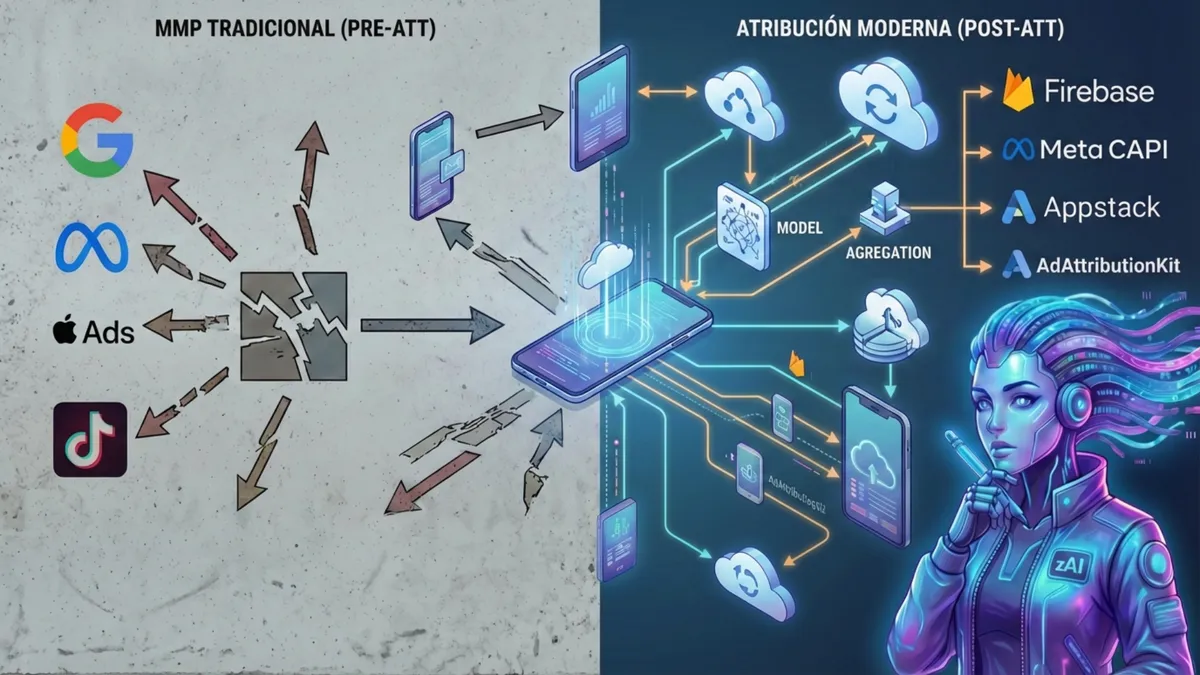
What MMPs Do (And What They No Longer Do)
Current Value
- Data Centralization: Consolidating multi-channel data into a single dashboard.
- Deduplication: Handling multi-touch attribution across different sources.
- Technical Integration: Connecting with SKAN/AAK to receive postbacks.
- Fraud Detection: Identifying invalid traffic (variable by vendor).
- Deep Linking: Routing users to specific in-app content (particularly Branch).
Value Lost
- Deterministic iOS Attribution: Impossible without IDFA.
- Real-time Optimization: SKAN introduces delays; AEM (Aggregated Event Measurement) is modeled.
- User-level Reporting on iOS: Now limited to aggregated or probabilistic data.
The uncomfortable economic question: Why pay $5K–$15K/month to display data that ad networks already provide for free in their own dashboards?
Alternatives: Platform by Platform
- Google Ads → Firebase: * Cost: $0. Firebase Analytics tracks installs and in-app events natively with direct Google Ads integration.
- Limitation: It only serves Google traffic.
- Applicable if: Over 60% of the budget is allocated to Google.
- Meta Ads → SDK + Conversions API (CAPI): * The combination of Meta SDK (client-side) and CAPI (server-side) offers better coverage for Meta traffic than an MMP. CAPI allows control over what data is sent and when, resulting in a better match rate.
- Trade-off: Requires technical implementation; it is not "plug-and-play".
- Apple Search Ads (ASA) → AdServices API or MMP: * ASA is the only channel with deterministic post-ATT attribution because it does not require an ATT opt-in. However, ASA natively only optimizes for installs, not downstream events.
- Reality: This is where MMPs still provide clear value, especially for teams lacking custom development resources to implement the AdServices framework.
- Programmatic → Requires MMP: * Networks like AppLovin rely on postbacks between the MMP and their platforms. Without an MMP, one must build custom click tracking, attribution logic, and real-time S2S (server-to-server) postbacks a task equivalent to building a "mini-MMP".
- Conclusion: If there is significant programmatic investment, an MMP remains justified.
The Tensions: Unresolved Issues
The Underestimated Cost of Switching
Leaving an MMP isn't just about "stopping the payment". It involves:
- A 2-3 month project to migrate integrations.
- Potential loss of historical data access.
- Reconfiguring BI dashboards that rely on the MMP's schema.
- Risk of visibility loss during the transition.
A team spending $200K/month on paid media could lose more in efficiency during a 3-month transition than they would save in a year of MMP fees.
For Those Who CANNOT Leave
Due to 2-3 year enterprise contracts, 6+ month procurement processes, or strict compliance requirements, many teams cannot simply "evaluate alternatives". For them, the focus shifts to:
- Are we using the features that justify the cost?
- Can we renegotiate during the next renewal?
- How do we complement this with platform-native solutions?
Appstack: Interesting, but Premature
Appstack, founded by Lucas Moscon (ex-RevenueCat), proposes receiving raw postbacks directly from Apple, removing the "enrichment" layer provided by ad networks.
- Current Status: In beta with 9 agencies across Europe and LATAM, and over 250 pre-registered apps.
- The Caveat: There is no public information regarding compliance, security certifications, or performance at scale. It is a solution to watch, not to implement today.
AdAttributionKit: The Future After SKAN
WWDC 2025 introduced significant updates to AdAttributionKit (AAK), the evolution of SKAN:
FeatureSKAN 4AAK (iOS 18.4+)Re-engagementNoYesAttribution WindowsFixedNetwork-configurableCountry CodesNoYes (in postbacks)Alternative StoresNoYes
Re-engagement is a game-changer for remarketing, while configurable windows allow adaptation for verticals with long conversion cycles. While SKAN is not yet deprecated, AAK is the path forward.
The Pivot: From Attribution to "Marketing Cloud"
The industry recognizes that last-touch attribution is dead:
- AppsFlyer (Nov 2025): Rebranded as a "Modern Marketing Cloud," launching 8 new products.
- Singular: Launched out-of-the-box MMM (Media Mix Modeling).
- Kochava: Introduced an AI workspace.
The future value lies in MMM, incrementality testing, and predictive analytics. The problem: MMM requires 1-2 years of historical data and statistical expertise, making it inaccessible for most teams.
Decision Framework
An MMP is likely worth it if:
- Over 30% of the budget goes to programmatic.
- Sophisticated cross-channel deduplication is required.
- Engineering resources for custom implementations are unavailable.
- Deep linking is critical for the product experience.
An MMP is likely NOT worth it if:
- Budget is concentrated in Google + Meta.
- Technical capacity exists for CAPI + Firebase.
- Cost efficiency is a higher priority than premium features.
- Measurement gaps in some channels are acceptable.
Unknowns & Application
- Appstack in Production: Real performance at scale remains to be seen.
- AAK Adoption: The migration timeline for networks and MMPs is still uncertain.
- Google Privacy Sandbox: Similar ATT-like changes are coming to Android.
- Pricing: As MMPs pivot to "Marketing Clouds," will prices rise or fall?
This applies to you if: You are evaluating an MMP renewal, launching a new app and deciding on an initial stack, or questioning if you are paying for actual value.
This content was developed with AI assistance and reviewed by the Zenda team. The limitations of the information were explicitly stated. If any of the data ages poorly, blame Apple's privacy ecosystem, not us.