
ChatGPT Ads Are Now in Testing: An Operational Update
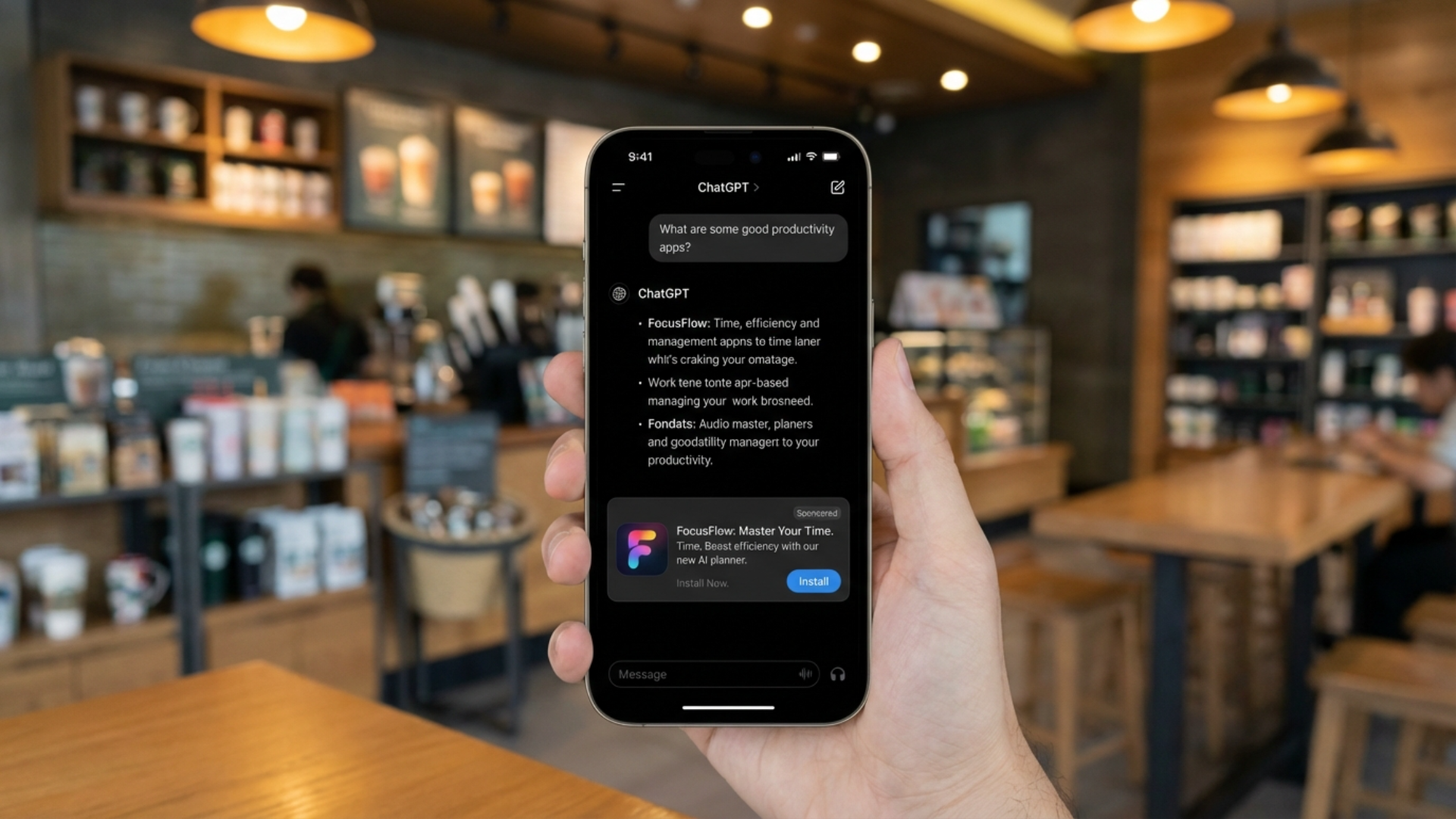
OpenAI started testing ads in ChatGPT for free tier users in the US. Ads appear below responses without influencing content. There's no buying platform and no performance benchmarks. The honest move today: awareness, not resource investment.
The context: from theoretical AEM to real testing
In our previous note on Answer Engine Marketing, we analyzed the strategic shift that advertising in conversational interfaces represents. That was the concept. January 2026 brought the implementation.
OpenAI activated ads in ChatGPT. This is no longer speculation: ads are running. The rollout is limited to free tier and Go plan users in the United States. Ads appear below responses, separated from content and clearly labeled as sponsored. OpenAI excluded audiences under 18 and sensitive topics like health, mental health, and politics. Users maintain control over personalization and can delete their ad data.
A revealing detail about OpenAI's strategy: they expect ads to represent less than 50% of their revenue. This suggests diversification, not a pivot.
Source: Engadget, February 2026
What doesn't exist yet
There's no public "ChatGPT Ads Manager." Testing appears to be with advertisers selected directly by OpenAI, which means most paid media teams can't participate even if they wanted to.
There's also no information about pricing models, targeting options, allowed formats, or reporting metrics. Without public benchmarks on CTRs or conversion rates, any performance estimate is speculation. And crucially, there's no timeline: OpenAI hasn't announced when it will be available for self-serve. Nobody knows if it'll be Q2 2026, Q4, or 2027.
The tension nobody's talking about: who sees the ads?
Ads are on the free tier. This raises an uncomfortable question few are asking: are ChatGPT free users the segment I want to reach?
Anthropic ran Super Bowl advertising highlighting that Claude has no ads. The implicit message is clear: users who value their time and pay for tools can choose ad-free alternatives. This fragments the market in a way that matters for paid media.
Think about it this way: free tier users are exposed to ads but potentially represent the lower purchasing power segment. Plus and Pro users never see advertising, making them inaccessible. Meanwhile, Claude positions itself as a premium alternative capturing those who prefer to pay rather than see ads.
The operational question is direct: if your target is power users with high LTV, are they in ChatGPT Ads inventory? Or have they already migrated to paid options? There's no data to answer this yet, but it's critical to consider before allocating budget.
The "Decision Traffic" concept
According to YepAds analysis, what differentiates ChatGPT Ads is the type of traffic. Social media traffic is passive: users scrolling without specific intent. Search traffic is active but transactional: a query looking for a specific answer. ChatGPT traffic is conversational, oriented toward solving a problem.
The hypothesis is that ChatGPT users are in "decision mode": researching solutions, comparing options. This could translate to better conversion than an Instagram scroll.
But here's an honest caveat: this is a reasonable hypothesis, not confirmed data. "Decision traffic" can mean "research mode" as much as "decision mode." The former is far from purchase, the latter close to it. Without benchmarks, it's speculation with logic, but speculation nonetheless.
What to do today
We don't recommend preparing specifically for ChatGPT Ads. Without knowing how targeting works, optimizing landing pages or "semantic positioning" for this channel is optimizing in a vacuum.
What does make sense is maintaining operational awareness. Knowing this exists, understanding the basic specs, being able to respond when the CEO asks "what are we doing with ChatGPT Ads?" with something more substantial than silence. Monitor OpenAI's blog, press releases in Search Engine Land and AdExchanger, and maintain communication with large agencies that usually get early access.
The most important context is that ChatGPT Ads doesn't exist in isolation. Google is integrating AI Overviews in Search with ad potential. Perplexity has ads. The "answer engine marketing" space is fragmenting. The strategic question isn't "ChatGPT Ads yes or no," but how much of your budget should be in AI surfaces versus traditional search over the next 12 months.
When to act
Timing depends on external signals, not internal urgency. When OpenAI announces a public beta, the move is to register and request early access. When the first case studies with real data appear, evaluate if it applies to your vertical. When the self-serve platform becomes available, test with experimental budget. And when industry benchmarks exist, only then make informed allocation decisions.
This varies by scale:
- A startup with less than $10K/month in paid should ignore ChatGPT Ads until there's a platform and benchmarks: the opportunity cost of getting distracted is greater than the benefit of being "early."
- A scale-up with $50K-200K/month can actively monitor, reserve experimental budget, and contact agencies with possible early access.
- Enterprise should include it in 2026-2027 channel planning without requiring immediate action, but ensuring board-level visibility.
Implications for Google
The uncomfortable question is whether ChatGPT Ads erodes Google Search value. There are arguments in both directions, and intellectual honesty requires presenting both.
The erosion case is based on informational intent migrating to chatbots, power users preferring conversational interfaces for research, and "zero-click resolutions" competing directly with Google's click-through model. If the answer is in the chat, why go search?
The counter case holds that ChatGPT doesn't have Google's volume, that for immediate transactions Search remains the dominant channel, and that testing is limited to a small segment in a single market. Mass behavior hasn't changed.
The honest position: it's early. The prudent approach is to observe user behavior shifts through your own analytics and not massively reallocate budget based on headlines.
What we don't know
The list of unknowns should moderate any premature enthusiasm. We don't know the self-serve platform timeline or the pricing model with its budget minimums. Targeting options are a mystery: will it work by keywords, context, interests? The real demographics of ChatGPT free versus paid users aren't publicly documented. There are also no performance benchmarks versus other channels, no clarity on available ad formats, availability outside the US, or what bidding competition will look like.
This is significantly more than what we know. Acting as if these unknowns didn't exist is conference keynote optimism, not paid media strategy.
Who this is for
This note makes sense if your CMO asked what's happening with ChatGPT Ads and you need an informed point of view. Also if you're planning channels for the second half of 2026 or you're interested in the AI marketing space as an emerging trend.
It doesn't apply if you're looking for a channel to invest in today because the platform doesn't exist. Nor if you need benchmarks to build a business case, if your budget is limited and you need efficiency over experimentation, or if you operate exclusively in markets outside the United States.
This content was developed with AI assistance and critiqued by three people who don't agree on anything. The result: an analysis that admits what it doesn't know, which is quite a lot.