Infillion acquires Catalina: real purchase data now in Programmatic
Catalina? Never heard of them
Catalina was founded in 1983 and has spent four decades operating as the largest deterministic purchase intelligence network in the world. The numbers: 70 retail banners, 130 million households covered in the United States, 11 billion shopping trips processed per year, and $600 billion in annual consumer spending tracked. "Deterministic" is not a marketing adjective: it means Catalina records actual transactions at the point of sale, rather than inferring purchase behavior from proxies like web browsing, cookies, or declared affinities.
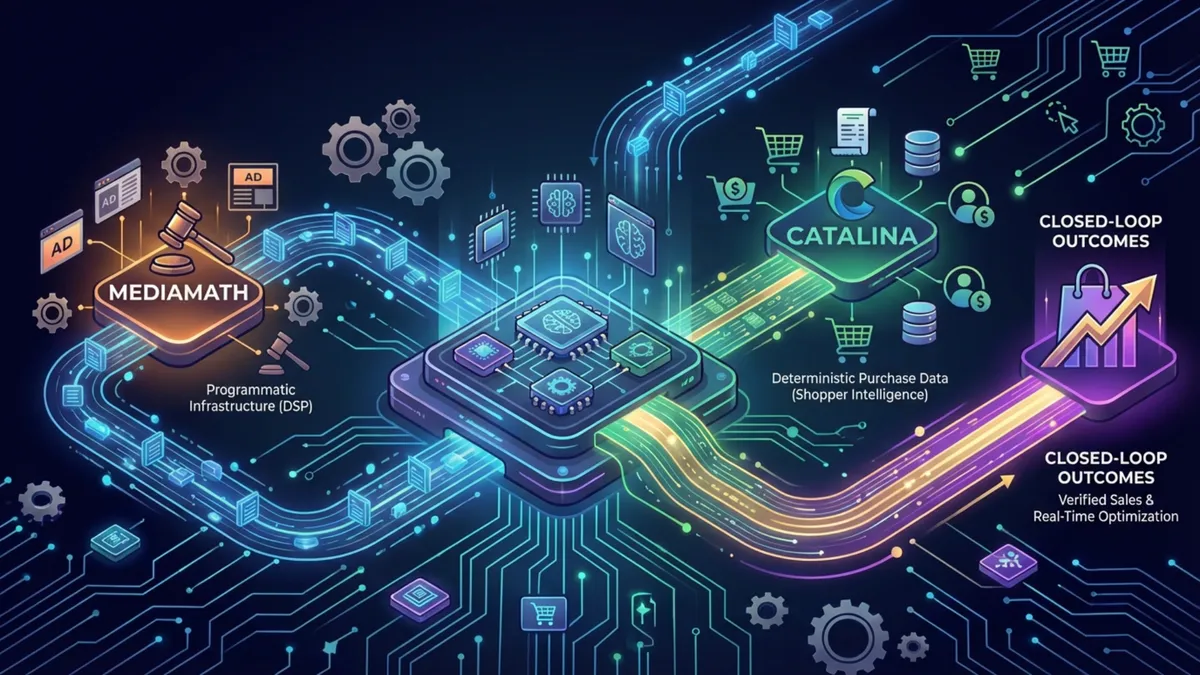
In practice, Catalina connects what a consumer bought with what they saw before buying it. For consumer packaged goods (CPG) brands, this has been the infrastructure that closes the loop between ad impression and verified sale for decades.
Infillion and the rebirth of MediaMath
Infillion is an adtech platform that in recent years executed an acquisition strategy with a clear logic. It first acquired the assets of MediaMath, one of the most recognized DSPs (demand-side platforms) in the programmatic ecosystem, and relaunched it as Infillion MediaMath. The platform operates with a modular architecture that integrates demand, data, creative, and supply through open APIs. Its identity engine, XGraph, connects people, households, and behaviors across multiple screens in a framework designed to operate without cookies. Its AI engine, The Brain, automatically optimizes budget allocation across strategies and channels.
More recently, Infillion launched the Agent Connector, a tool designed to manage AI agent-controlled media buying. The company positions itself as "the first composable agent-native platform in adtech."
The acquisition of Catalina on February 23, 2026 is the third move in that strategy: DSP (MediaMath), agentic execution (Agent Connector), and now the source of purchase truth (Catalina). The combination allows, in theory, an advertiser to segment audiences based on real purchase behavior, buy programmatic impressions optimized by AI, and measure impact by verifying point-of-sale transactions, all within a single platform.
Closed-loop advertising within a single stack
What Infillion achieves with Catalina is something no other independent DSP can replicate today. Media buying teams historically need multiple layers to connect advertising with sales: a DSP to buy impressions, a data partner to segment audiences by purchase behavior, and a third party for sales attribution. Infillion collapses those three layers. Catalina's data will power custom bidding algorithms that optimize media buying to drive sales specific to each retailer's customer base, using real purchase data, not inferred.
This is significant in an ecosystem where cookie deprecation and privacy restrictions have reduced the precision of web behavior-based targeting. When digital signals weaken, real purchase signals gain value. Infillion now has the strongest signal in the market.
The exclusivity that changes the dynamic
The acquisition announcement confirms that Catalina's data will eventually be exclusive to the Infillion platform and will not be offered as a standalone business that other ad platforms can buy or license. There is a transition period to migrate current Catalina clients who operate with other DSPs, but the direction is clear: the most comprehensive purchase data in the market becomes a resource controlled by a single player.
For competing DSPs, this means losing access to a data source that has been central to CPG and retail campaign optimization. Alternatives exist but operate at different scales or with different coverage. IRi/Circana has strength in certain consumer packaged goods categories. Nielsen maintains purchase panels. dunnhumby operates data networks with specific retailers. LiveRamp connects data sources through its identity graph. None of these options replace Catalina one-to-one in household coverage and retailer diversity, though in combination they can cover parts of the gap.
The question for the ecosystem is not just whether Catalina's data is replaceable (partially, it is), but whether concentrating deterministic purchase data within a single DSP creates a competitive imbalance that pressures the entire market to compete for proprietary data sources. The Trade Desk, the most successful independent DSP in the market, does not have an asset comparable to Catalina. How it responds will be an indicator of where the ecosystem is heading.
Will the exclusivity hold?
A nuance worth including that the urgency of the announcement should not obscure: the history of adtech shows that exclusivity strategies soften when revenues don't grow at the expected pace. Infillion needs its DSP to gain market share for Catalina's exclusivity to make economic sense. If Infillion MediaMath fails to capture a significant share of buyers currently operating on The Trade Desk, DV360, or Amazon DSP, the pressure to license Catalina's data to third parties (generating direct revenue) may outweigh the value of keeping it exclusive. The market has correction mechanisms, and exclusivity is not destiny: it is a bet.
LATAM: the ecosystem growing without equivalent measurement infrastructure
While in the United States the discussion is about who controls deterministic purchase data, in LATAM the discussion should be about why that infrastructure doesn't exist at a comparable scale.
The growth numbers are impressive. Retail media investment in the region is growing at 28% annually, 2.4 times faster than digital advertising overall. Total retail media spending is projected to double by 2029, reaching USD $5.2 billion. Brazil and Mexico lead with projected growth of 42% and 40% respectively, double the global average. Mercado Libre holds 53% of regional retail media investment, with 6.7% of all digital advertising investment in LATAM.
But there is a structural difference that the growth percentages conceal. Mercado Libre has transaction data within its marketplace: it knows what its users bought, how much they paid, and how often they return. It is valuable data. But it is data from a single ecosystem, limited to purchases within its platform. Catalina operates across retailers, connecting purchase data from 70 different brick-and-mortar chains. The difference between what Mercado Libre can offer and what Catalina provides to Infillion is the difference between a retail media network (which monetizes its own audience) and an interoperable purchase intelligence network (which connects purchase behavior across the entire retail ecosystem).
In LATAM, supermarkets and physical retailers operate with fragmented loyalty systems, no interoperability, and no data layer connecting them. Operators like dunnhumby have a presence in some regional markets (Brazil, Chile), but at a much smaller scale than Catalina in the US. No player can offer advertisers in the region what Catalina offers in the United States: a unified view of consumer purchase behavior across multiple retailers.
The result is a paradox: LATAM invests more in retail media every year, but the ability to measure the real impact of that investment grows much slower than the money being spent. The acquisition of Catalina by Infillion does not create this problem, but it makes it visible: while the US consolidates measurement infrastructure (even within a walled garden), LATAM operates with estimates, proxies, and incomplete attributions.
Proprietary data vs. technology: where is the real advantage?
The acquisition narrative suggests that the competitive advantage in programmatic has shifted from DSP technology to proprietary data. There is evidence in favor: in a post-cookie world, whoever holds verified first-party data has a structural advantage. But the argument needs nuance. The Trade Desk does not have Catalina and is the most successful independent DSP in the market, with a market cap that far exceeds Infillion's. DSP technology still matters: reach, latency, SSP integrations, reporting capabilities, UI/UX, and the quality of optimization algorithms are factors that weigh in a media buyer's decision. Proprietary data is a powerful competitive advantage, but it is not the only one that matters.
For LATAM, the open questions are even more fundamental. It is unclear whether any regional player plans to build an interoperable purchase data network. It is not clear whether the region's physical retailers have the interest or technical capacity to share transaction data at scale. And it remains to be seen whether the growth of retail media in the region will generate the pressure needed for this infrastructure to develop, or whether LATAM will continue operating with a measurement gap that grows proportionally to its investment.
Developed with AI. Reviewed by humans. If any data ages poorly, blame the ecosystem, not us.