
Manus AI in Meta Ads Manager: the platform now also operates your account
Meta integrated Manus AI into Ads Manager as an autonomous agent available to all advertisers. Current capabilities are reporting and analysis, not campaign execution. But the conflict of interest is structural: the platform that sells your inventory now also controls the intelligence layer inside your account.
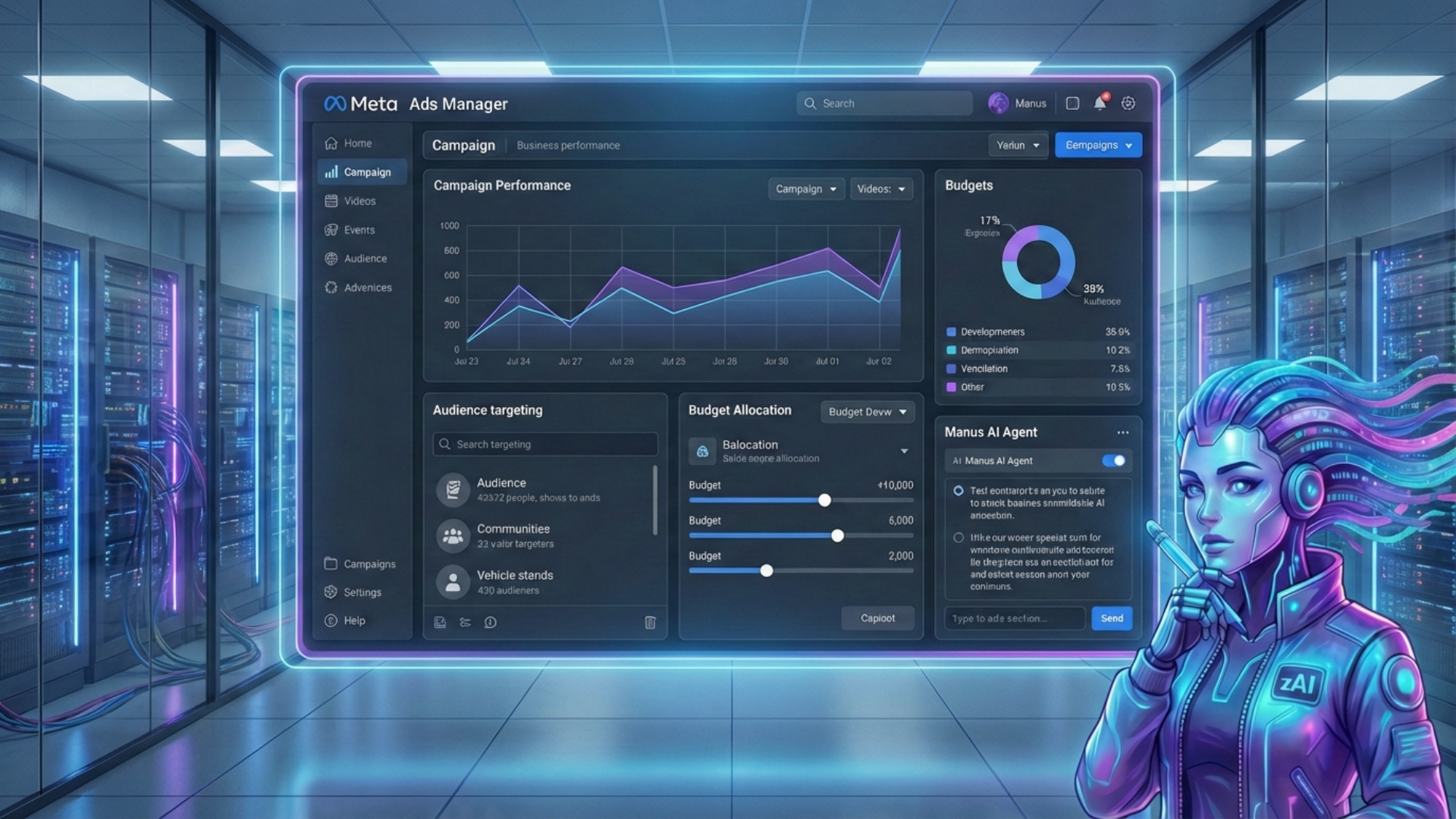
On February 17, 2026, Meta began integrating Manus AI directly into Ads Manager. Advertisers can find Manus in the platform's "Tools" section, and some are receiving in-stream prompts inviting them to activate what Meta describes as their "new AI work partner." The agent can automate tasks such as data analysis, report generation, and audience research.
Manus is not an in-house Meta development. It is a Chinese general-purpose autonomous agent startup that Meta acquired in December 2025 for a reported value exceeding $2 billion. Before the acquisition, Manus positioned itself as an "execution layer" for turning AI capabilities into scalable operating systems, having processed according to its own blog over 147 trillion tokens and created over 80 million virtual computers in just a few months. The company continues to operate from Singapore, as confirmed in its post-acquisition statement.
This is not a future announcement or a closed beta. It is live in accounts, ready to be activated. The decision of whether to do so is already on the table for paid media teams.
What Manus can do today (and what it still can't)
The capabilities confirmed by multiple sources are automated report generation, audience research, performance data analysis, and automation of routine operational tasks. What has not been confirmed, and this is a crucial distinction, is the ability to autonomously create or modify campaigns, optimize bidding or budgets, generate creatives, or take any action that alters campaign settings without human intervention.
Today, Manus appears to operate as an analysis assistant. But the direction is explicit: Mark Zuckerberg stated that "agents are valuable because they understand personal context, including history, interests, and relationships." Meta plans to sell Manus as a service and integrate it into next-generation products focused on social commerce. Evaluating Manus only by what it does today means ignoring the trajectory declared by the company itself.
The conflict of interest nobody mentions
Media coverage of the launch has been uniformly descriptive: "Meta launched Manus, here are the features, here's how to activate it." The missing angle is the structural conflict of interest this integration represents.
Meta operates a model where it monetizes ad inventory: the more ads run and the more budget allocated to the platform, the more it bills. Simultaneously, it now offers an agent inside the advertiser's account that generates the analysis and insights on which the advertiser makes budget decisions. No malicious intent needs to be assumed to see the problem: a system designed to maximize platform usage is generating the metrics the advertiser uses to evaluate whether the platform works.
This is not conceptually new. Walled gardens have always graded their own homework. Facebook overcounted video views in 2016, a scandal that impacted budget decisions for thousands of advertisers globally. Google faced multiple controversies around ad viewability. The industry's response was to demand independent measurement through third parties like DoubleVerify, Moat, and IAS. Manus introduces a new layer of this same problem: now it is not just the measurement coming from the vendor, but also the interpretation and analysis.
The question of scale
The tension between efficiency and independence is not resolved with a generic "it depends." It is resolved by understanding that the answer changes based on operational scale.
For a startup media buyer managing $5K per month with a two-person team, analytical independence was already lost long ago. Advantage+ controls bidding, Meta chooses where to show ads, and targeting has been progressively automated. In that context, a Manus-generated report does not introduce a new risk: it is one more automation layer in a stack that already depends entirely on the platform. The efficiency benefit (hours saved on manual reporting) likely outweighs any theoretical conflict-of-interest risk. The practical recommendation is to activate, compare a Manus report with a manual report to validate consistency, and use the tool for what it's worth: saving time on low-strategic-value tasks.
For a head of paid media managing $200K per month with a team of six, the equation changes. At that scale, a flawed insight can translate into reallocation decisions worth tens of thousands of dollars. The point is not to reject Manus, but to establish controls: do not make budget decisions based solely on Manus analysis, maintain independent reporting as a verification layer, and document any discrepancies between the agent's insights and your own analysis. The operational question these teams should be asking is not "do I use Manus?" but "who on my team is responsible for auditing what Manus produces?"
For a marketing director at a corporate, the governance layer is the priority. Legal needs to evaluate the terms of service. Compliance needs to understand what data the agent accesses. The question of data sovereignty, given that Manus continues to operate from Singapore, may be a deal-breaker depending on jurisdiction. And the EU AI Act, fully applicable since 2025, imposes transparency and human oversight requirements on high-risk AI systems that could apply to an autonomous agent operating within advertising accounts.
Efficiency vs. independence
The promise of Manus is real: automating reports and analysis saves time. For understaffed teams juggling everything, that has concrete value. But the efficiency Manus offers comes with a cost that doesn't appear on any pricing page: the consolidation of yet another operational function within Meta's walled garden. Every task Manus absorbs is one fewer task the advertiser's team performs, and therefore one fewer decision made with independent data. For some, that trade-off is acceptable. For others, it is exactly the kind of incremental dependency that erodes bargaining power with the platform over time.
Agencies: efficiency for the advertiser, threat to the intermediary
If Meta can automate reporting, audience research, and data analysis within the platform, a significant portion of what paid media agencies charge becomes commoditized. The value that survives lies in the layer Manus cannot provide: cross-channel strategy, independent measurement, and business context that doesn't live inside Ads Manager. Agencies whose value proposition is "we manage your Meta account" have a problem that didn't start with Manus but that Manus accelerates considerably.
Free tool or data play?
Manus is available at no apparent additional cost within Ads Manager. This raises a question that the System in Motion article poses indirectly: if the product is free, what is the real monetization? Agent usage data, advertiser decision patterns, the questions advertisers ask Manus about their own campaigns: all of this constitutes a layer of competitive intelligence Meta didn't have before. One doesn't need to be conspiratorial to observe that Meta now knows not only what advertisers do, but how they think about what they do.
Who this is for (and who it isn't)
This analysis is relevant for any advertiser operating on Meta Ads who encountered the Manus prompt this week. If you manage accounts with a small budget and a small team, the conclusion is pragmatic: activate and use for operational efficiency, without delegating strategic decisions. If you manage significant accounts or report to a CMO or board, you need a governance policy before your team adopts Manus unevenly. If you lead marketing at a company with operations in Europe or in regulated industries, legal and compliance evaluation should precede activation.
This does not apply if you're looking for a deep technical analysis of Manus's architecture (there isn't enough public documentation), if you need agent performance benchmarks (they don't exist), or if you operate exclusively outside Meta Ads.
What we don't know
The list of unknowns should moderate any extreme position on Manus, whether unconditional enthusiasm or outright rejection. There is no public documentation on exactly what account data the agent accesses or whether it stores information outside Meta's servers. It is unclear whether post-acquisition Manus still relies on third-party LLMs like Anthropic and OpenAI or has already migrated (or will migrate) to Llama, Meta's own model, which would significantly change the technological dependency analysis. Meta has not published an accountability framework for agent errors. The Chinese regulatory investigation into the acquisition remains open, with potential implications for the tool's operational continuity. And the speed at which Meta expands Manus's capabilities, from reporting to potentially active campaign optimization, is an unknown that determines whether this analysis ages well or becomes obsolete in weeks.
There is also no adoption data: how many advertisers have activated Manus, what results they're seeing, and whether discrepancies between Manus insights and independent analysis are significant. Until that data exists, any definitive conclusion is premature.
An AI wrote the first draft. A team of humans improved it. Or so we hope.