
Stripe Enters Facebook Ads: Native Checkout, the Agentic Commerce Protocol
Stripe launched native checkout inside Facebook Ads where users can buy without leaving the app. This isn't just a payments feature: it's the first concrete step toward a model where the funnel compresses to ad-to-checkout. For paid media teams, the urgent question isn't whether to activate, but how to measure when the click to your site disappears.
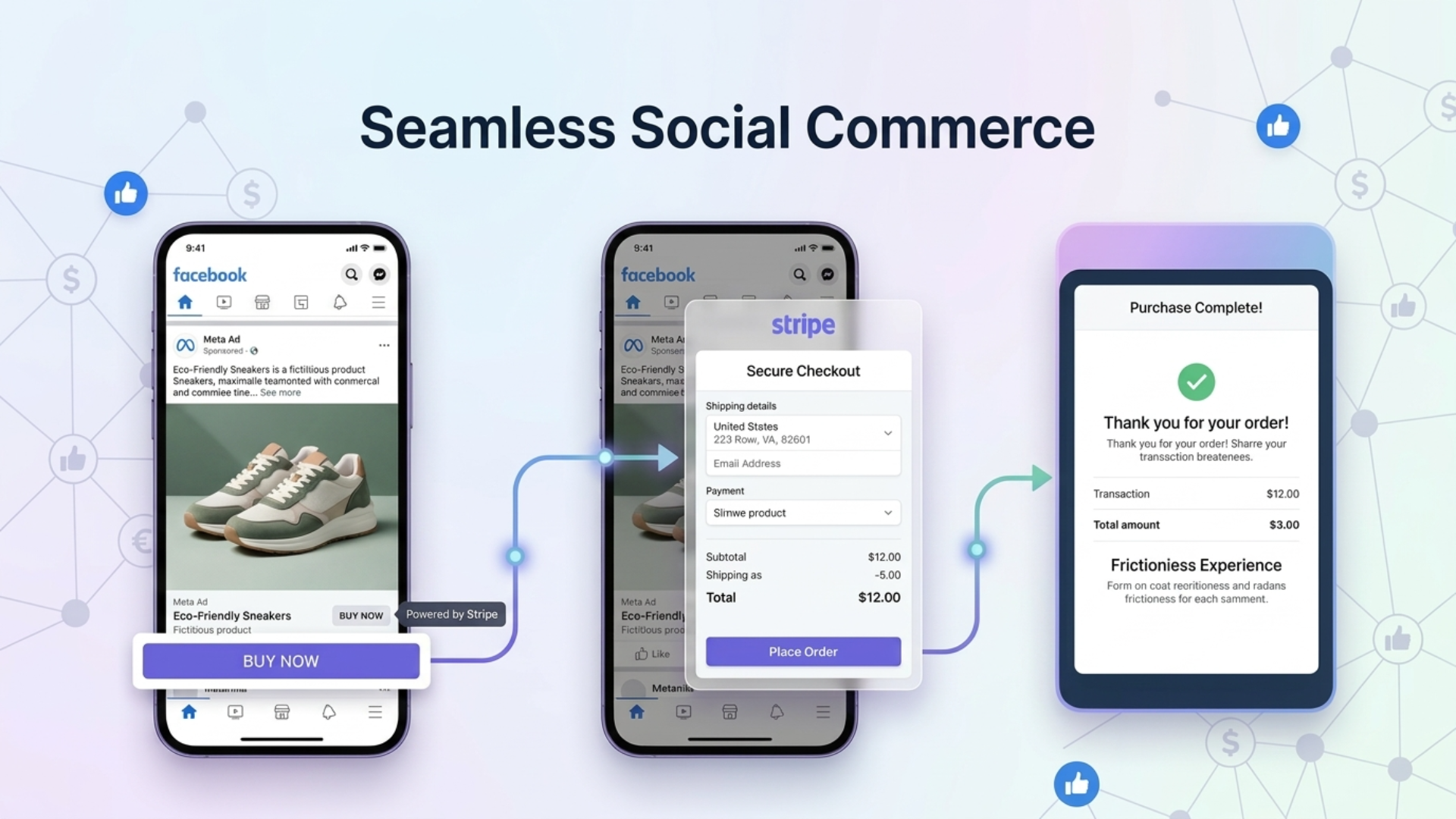
Stripe announced an integration with Meta that lets merchants enable direct purchases inside Facebook Ads. The mechanism is straightforward on the surface: the merchant flips a toggle in their Stripe Dashboard, connects their Meta Ads account, and users who see an ad with a "Buy now" button complete the purchase inside Facebook using saved credentials from their Meta wallet. Stripe processes the payment. The user never visits the merchant's site.
The first merchants in production are Fanatics (sports merchandise) and Quince (DTC apparel). Kevin Miller, Stripe's Head of Payments, described the integration as progress toward "commerce infrastructure suited to the AI era." Stripe confirmed the experience will expand to Instagram Ads and other Meta surfaces.
The technical infrastructure behind this is the Agentic Commerce Protocol (ACP), an open standard co-developed by Stripe and OpenAI. ACP allows platforms and AI agents to initiate transactions using Shared Payment Tokens (SPTs): payment credentials scoped to a specific seller, with time and amount limits, that don't expose the buyer's actual data. Stripe Radar operates on each transaction with risk signals for fraud detection.
This isn't happening in a vacuum. In January 2026, Google launched the Universal Commerce Protocol (UCP) at NRF with backing from Shopify, Walmart, Target, Etsy, and Wayfair. Stripe already confirmed that its Agentic Commerce Suite will support UCP automatically. Two protocols, one Stripe integration: the ecosystem is reorganizing around purchases embedded in the discovery platform.
The funnel you know just lost a few steps
The standard Facebook Ads model has worked like this for a decade: the user sees an ad, clicks, lands on the site, browses, completes checkout. Each step generates data: pixel fires, cookie drops, session tracking, cart events. That data feeds retargeting, lookalike audiences, and attribution models. Native checkout eliminates half of those steps, and with them, half of that data.
When the purchase happens inside Facebook, the merchant receives the transaction via Stripe (payment confirmation, shipping data, order information), but doesn't get the site visit. No pageview. No session. No cookie. Meta's pixel registers the conversion because it happens on its own platform, but the merchant loses visibility into the pre-purchase journey.
This doesn't inaugurate the attribution crisis. iOS 14.5 already did that in 2021, and each iteration of SKAdNetwork deepened it. What native checkout does is make it structural: data isn't lost due to privacy restrictions anymore; data is never generated because the user never leaves Meta. The gap between what Meta reports and what your analytics can confirm will grow, and this time it's not a modeling problem, it's an architecture problem.
The first-party data trap
The industry has spent years repeating that first-party data is the strategic asset. Native checkout inverts that dynamic. The buyer's data (wallet, purchase history, preferences) stays in Meta. The merchant receives the minimum necessary for fulfillment. In practice, Meta accumulates more transactional data, not less, and the merchant accumulates less, not more.
There's a concerning compounding effect: if Meta uses in-platform purchase data to improve its bidding and targeting (which is likely, though not confirmed), merchants who activate native checkout will feed an algorithm that benefits the entire platform, including their competitors. And merchants who don't activate it could end up at a disadvantage not just in purchase friction, but in the quality of audiences they receive.
ACP vs UCP: two visions for AI-powered commerce
The existence of two competing protocols reveals a deeper tension about who controls the relationship with the buyer.
ACP (Stripe/OpenAI) focuses on the transactional moment: an efficient checkout inside any AI or social surface. Its logic is that the AI agent (or platform) becomes the primary commerce surface, and the merchant provides the product and fulfillment. ACP optimizes for transactional speed with minimal handshakes between the agent and the payment system.
UCP (Google/Shopify) covers the full journey: product discovery, consideration, purchase, order management, fulfillment, returns, and loyalty. Its logic is that the merchant retains control of the relationship and the agent is just another channel, much like Google Shopping is today. UCP uses OAuth 2.0 for authentication and sends risk signals directly to the merchant, who maintains their own fraud infrastructure.
The strategic difference is real. ACP bets that the conversational interface (ChatGPT, Meta, agents) captures the relationship. UCP bets that the merchant retains the relationship and agents are intermediaries. For a paid media team, the practical implication is that you'll need to support both, just like in 2015 you needed SEO and SEM to capture the full spectrum of purchase intent. Stripe already solved the technical part with a single integration. The measurement and attribution part remains unsolved by anyone.
"Isn't this just TikTok Shop with a different name?"
TikTok Shop has offered native checkout for years and hasn't transformed paid media. The difference is infrastructural, not conceptual. TikTok Shop is proprietary: it works only on TikTok, with TikTok's processor, and has its own fulfillment rules. Stripe's checkout on Facebook runs on an open protocol (ACP) that the merchant already uses for their own website. It's not another closed channel: it's the extension of an existing stack to a new surface. That doesn't guarantee it'll work better, but it does mean the adoption barrier is radically lower.
Conversion vs. control
The central tension is that native checkout promises to reduce friction and improve conversion, but the cost is ceding more data and more journey control to Meta. For a growth lead with limited budget, the trade-off may be acceptable: you capture the purchase where the user already is. For a head of paid who needs to justify ROI to a CMO with cross-channel attribution, the loss of post-click visibility is a real problem. And for a marketing director who needs to clear legal and compliance, the question of who is the merchant of record in an in-platform transaction (Stripe processes, Meta is the surface, the merchant provides the product) has no public answer yet.
The metrics you know don't work for this model
If CPA on Meta drops because conversion is easier inside the platform, is that checkout efficiency or ad efficiency? How do you separate the effect? Traditional paid media metrics (CTR, CPC, post-click CPA) assume a click to the site as an intermediate event. Without that click, the measurement framework needs to evolve. The most likely approaches are incrementality testing (measuring the causal effect of the ad, not the click) and media mix modeling (measuring channel contribution, not individual conversions). Both existed before, but they shift from "nice to have" to the only credible way to measure.
This has immediate application if you're a US-based merchant already using Stripe, selling impulse-purchase products (apparel, accessories, merchandise, consumer goods), and your CAC on Meta Ads is a metric you actively manage. Activating native checkout is a toggle. The risk is low and the experiment is reversible.
For teams in LATAM, the application today is preparatory. Stripe's native checkout on Facebook isn't available outside the US as of this publication. But the logic of the model (purchases embedded in the discovery platform) is already operating in TikTok Shop, already on Google's roadmap with UCP, and already on Meta's roadmap with the expansion to Instagram. What's coming isn't a feature: it's an architectural shift in how digital commerce works. Teams that start adapting their measurement and operations now will be better positioned when it arrives.
For high-ticket brands, long sales cycles, or products that require significant customization before purchase, native checkout in its current form doesn't apply. A one-tap purchase works for a $40 t-shirt, not for $50K/year B2B software.
There is no real conversion data. Fanatics and Quince haven't published metrics. We don't know the actual uplift vs. the traditional click-to-site flow.
We don't know the pricing differential. Stripe hasn't disclosed whether native checkout inside Facebook Ads carries different fees from the standard 2.9%+30c, or if Meta charges anything additional for the surface.
We don't know when this reaches LATAM. Meta wallet and Stripe have different coverage by market. The current integration appears limited to the United States.
We don't know how regulators will treat the concentration of transactional data in Meta. The European Union, with the DMA and GDPR, already has precedents for intervening in how platforms use commerce data. If Meta uses native checkout data to improve targeting, regulatory scrutiny is likely.
We don't know who assumes responsibility for chargebacks, disputes, and tax compliance in native checkout transactions. This is critical for legal and finance teams, and neither Stripe nor Meta have published details.