Search as a checkout: what Google's Connected Apps means for ecommerce in LATAM
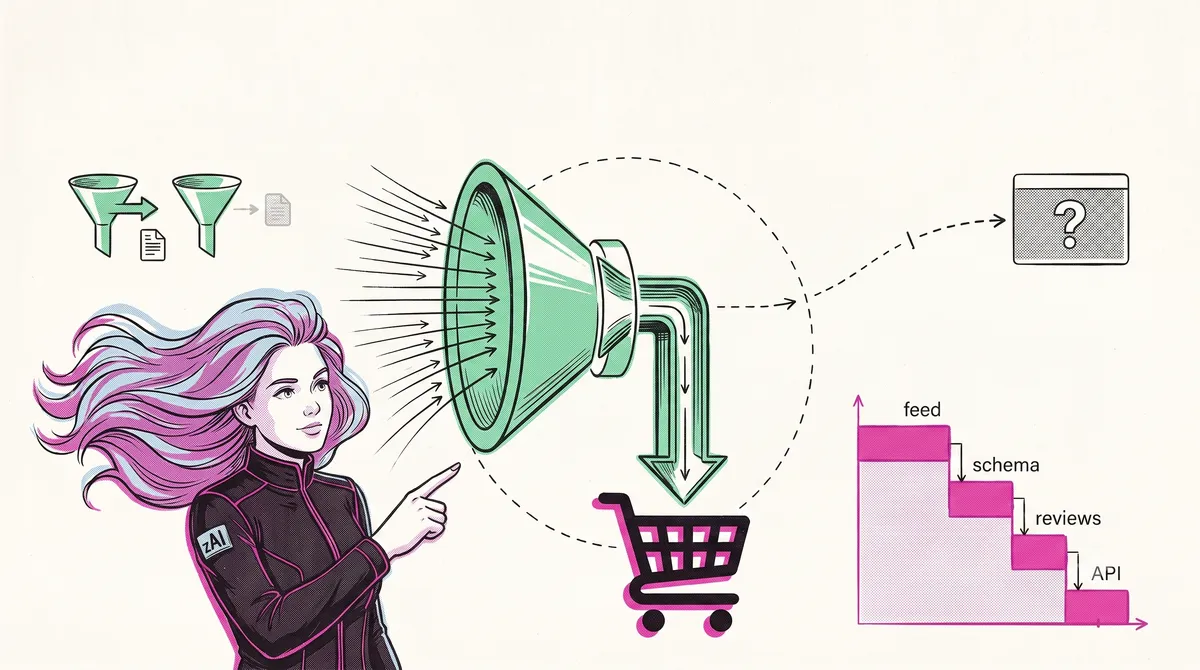
On July 16, Google switched on Connected Apps in AI Mode, and it is worth paying attention. From the search bar, a user in the United States can now add a recipe's ingredients to an Instacart cart and check out without leaving Search, ask Canva for a design template, or build a playlist and drop it straight into their YouTube Music account. The feature itself matters less than what it reveals: the conversion point is moving from the advertiser's landing page to the agent's interface, and with it moves the KPI that organized paid media for twenty years, the click.
Connected Apps is not new to Google. It debuted earlier in 2026 with Gmail and Google Photos; what changed in July is the arrival of external partners with transactional functions. Instacart lets you finish checkout with a few taps from inside Search; Canva generates templates with access to your calendar context; YouTube Music deposits the playlist into your account with playback controls embedded in the chat. Google said it is working with more partners, without naming them or giving dates, and for now the restriction is geographic: United States only. Third-party integrations in assistants are not new (Instacart was on Alexa, on Apple Maps, on Google Maps), but the difference is depth: in those cases the assistant redirected the user to Instacart; here the purchase closes inside the search interface.
The click stops being the axis
The paid media funnel has an implicit architecture that is rarely made explicit: search generates intent, the ad captures it, the click takes the user to the advertiser's domain, and conversion happens there. The entire measurement stack, Google Ads, Analytics, the pixels, CRO, remarketing, is built on that flow. The click to the site is the axis of everything.
Connected Apps introduces a fork. For the categories Google brings into the agent system, the user can go from intent to checkout without visiting the advertiser's domain. The click does not disappear, it will likely remain an option, but it stops being the only path. And when the advertiser is not integrated into the agent's data layer, the user may not only skip the click to their site: they can convert with a competitor who is integrated. What matters in that environment is not CTR to the site, but presence in the product layer that feeds the agent: the Merchant Center feed with structured data, current prices and availability; Product and Offer markup on the site; the reviews the agent uses as a signal; and the API connection to checkout that makes the transaction possible without leaving.
The data you lose, not just the visit
The most common analysis stops at the funnel: the click is lost. There is something deeper. If a user buys on Instacart from AI Mode and never enters the ecommerce site, the conversion event does not show up in Analytics, does not fire the remarketing pixel, does not feed the audience model, and that buyer's first-party data never reaches the CRM. The advertiser loses the buyer as data, not just as a click.
It is the same structural pressure documented in the Bocconi study on search erosion, where queries answered inside ChatGPT generate no referral. But in paid the math is worse: it is not only the visit that is lost, it can be the record of the buyer. Attribution, remarketing, lifetime value, all of it depends on holding that data. In a model where checkout happens in the agent's interface, that data stays with Google, not with the advertiser. The economics of the integrations are not public, but the platform logic, consistent with how Google behaved in Shopping and Hotel Ads, suggests that access to the conversion layer is not free for partners and that Google captures conversion data it can use for its own bidding models.
What to check before it reaches the region
Preparing is not a six-month project, it is a set of priorities. The most basic layer is the one most teams have incomplete: a clean, up-to-date product feed in Google Merchant Center, with real-time availability, rich attributes (variants, materials, SKUs) and correct prices. Without that feed, the agent has nothing to show and nothing to operate with. The second layer is schema.org markup on the site (Product, Offer, AggregateRating): not complex, but it takes development time. The third, verified reviews and inventory API connectivity, is more specific to the transactional model.
For a team with limited resources, the order worth considering: the feed first, high leverage and already impacting Shopping and Demand Gen today; the schema on product pages second, improving structured SEO right now; reviews at scale third, influencing LLMs and quality score. The checkout API is the layer that takes the most investment and depends most on the integration with Google existing for the region.
The integration that also costs you control
There is a tension worth naming. To be in the agent's conversion flow, the ecommerce needs to integrate more deeply with Google. But that integration means ceding part of the control over checkout, over the buyer's data, and over the direct relationship with the customer. How much is ceded depends on the terms Google sets with each partner, which today are contractual and undocumented.
The parallel with retail media is useful. As we argued in the note on the consolidation of retail media in LATAM, the concentration of purchase data in a few platforms is not new. The difference is that the concentrator is now the search entry point, not just the point of sale: Google positions itself as the intermediary of both intent and transaction at once. For anyone who has to defend this to a board or to legal, the privacy question is legitimate and has no public answer: what user data Google retains when checkout happens in AI Mode. What is documented is that these integrations require authentication, which gives Google visibility into the context (calendar, location if enabled, history) to personalize responses.
Where you stand today
This applies now, in preparation mode, to any ecommerce operation in LATAM that already sells actively on Google Shopping, meaning it already has Merchant Center, spends more than 50,000 dollars a month on search, and has some level of structured data on the site. For those teams, the feed and schema work worth doing is not merely speculative: it improves the performance of current campaigns and leaves them better positioned for when Connected Apps expands. For smaller operations, without an active Merchant Center or with an outdated feed, agentic-specific preparation is a low priority next to more immediate problems; measuring what already runs well, as we discussed in the note on how to measure ads in AI channels, matters more.
When it reaches the region has no confirmed answer. The indirect signals point to Mercado Libre, Rappi and Walmart Connect in Mexico and Brazil, with their own data structures and assistant models under construction, as the first candidates to integrate. And it is worth being honest about what we still do not know: Connected Apps is less than a week old, there is no conversion or adoption data, the economic model is opaque, and whether users actually close a purchase inside the search bar is a hypothesis, not a proven fact. None of that changes the operational conclusion: the feed and the schema get prepared now, no matter which platform consumes them first.
AI-assisted content, challenged by three people who never fully agreed. This is what came out.